Writing
Freelance vs In-House Web3 Developer: Best Choice
Should your crypto startup hire an in-house engineer, freelance Web3 developer, or agency? Compare costs, timelines, benefits, and tradeoffs.
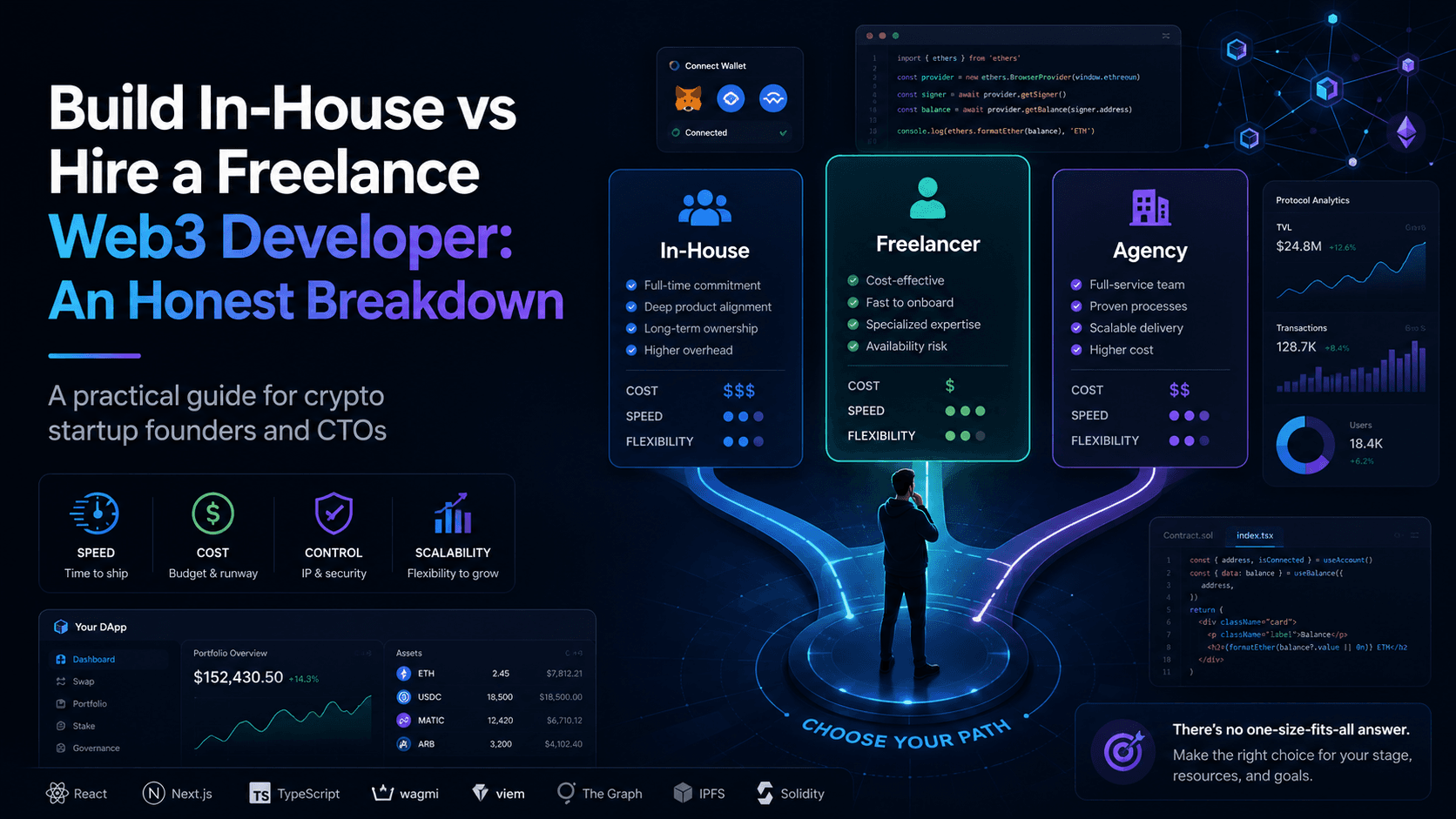
Build In-House vs Hire a Freelance Web3 Developer: An Honest Breakdown
By Khalil Ahmed
If you are building a crypto, DeFi, fintech, or Web3 product, one of the decisions you will eventually face is how to staff your frontend development.
Do you hire a full-time Web3 developer?
Bring in a freelancer?
Or hand the project to an agency?
There is no universally correct answer.
This is not really a question of which option produces better software. A strong in-house engineer can build an excellent product. So can an experienced freelancer. A good agency can also deliver a complicated platform successfully.
The real question is resource allocation.
What does your company need at its current stage? How much work is actually available? How quickly do you need to ship? How much runway do you have? And how certain are you that today's technical requirements will still be the same six months from now?
For an early-stage crypto startup, especially one at Series A or earlier, those questions matter more than whether one hiring model sounds more professional than another.
Here is a practical breakdown.
The Case for Hiring In-House
There are situations where hiring a full-time frontend engineer is clearly the right decision.
The strongest signal is simple:
You know you will have continuous frontend work for at least the next 12 months.
Maybe your application itself is the core business.
You are building a trading platform, DeFi protocol interface, crypto wallet, blockchain analytics product, institutional dashboard, or another application where the frontend is constantly evolving alongside the protocol.
You are not building one dashboard and moving on. You have an ongoing roadmap.
That roadmap might include:
-
wallet integrations
-
transaction flows
-
portfolio tracking
-
analytics
-
account management
-
onboarding
-
staking
-
liquidity interfaces
-
governance
-
notifications
-
mobile responsiveness
-
performance optimization
-
new chains and protocols
-
continuous UX improvements
In this situation, having someone embedded in the company creates real advantages.
An internal engineer gradually builds deep product knowledge. They understand why certain architectural decisions were made, how the contracts work, where the APIs are fragile, what users complain about, and what the product team plans to build next.
That accumulated context becomes valuable.
There is also less friction when priorities suddenly change. Your engineer is already inside Slack, already attending product discussions, and already familiar with the codebase.
But founders should also understand what "hiring one engineer" really means.
A strong frontend or Web3 engineer in many international markets may cost somewhere around $90,000-$130,000 per year in salary alone.
Then add benefits, equipment, payroll expenses, recruiting costs, and potentially equity.
The bigger cost for an early-stage startup is sometimes not money, but time.
Finding the right person can easily take two or three months.
You need to source candidates, screen them, conduct technical interviews, negotiate compensation, wait through notice periods, and then onboard them.
Even after hiring, the engineer will need time to understand your architecture, contracts, APIs, deployment process, design system, and product.
If your roadmap supports that investment, it can absolutely be worthwhile.
If you need to launch in six weeks, however, a three-month recruiting process is not especially helpful.
The Case for Hiring a Freelancer
Freelancers make the most sense when the work has relatively clear boundaries.
For example, imagine your protocol team has finished the first version of its smart contracts and now needs a frontend where users can connect a wallet, deposit assets, view their positions, and claim rewards.
That is a defined project.
You may eventually need a large internal engineering team, but you do not necessarily need it today.
A freelancer can be useful for situations such as:
-
building a V1 or MVP
-
developing a Web3 dashboard
-
implementing wallet connectivity
-
integrating smart contracts
-
building a staking interface
-
creating a token migration portal
-
developing portfolio or analytics interfaces
-
integrating an existing frontend with new APIs
-
handling a temporary increase in engineering workload
Another common situation is the bridge hire.
Your startup knows it wants a permanent frontend engineer, but finding the right person may take months.
Instead of putting product development on hold, you bring in an experienced freelancer to keep the roadmap moving while recruiting continues.
Specialization is another reason.
You might have an excellent general frontend team but suddenly need someone familiar with Wagmi, Viem, WalletConnect, smart contract interactions, subgraphs, DeFi position data, or multi-chain transaction flows.
Hiring someone permanently for a requirement that lasts six weeks may not make financial sense.
Freelancing has downsides too.
The biggest is availability.
Good freelancers usually have other clients. Unless you have contracted dedicated capacity, you cannot always assume they will be available whenever something appears.
There is also handoff risk.
If the freelancer builds an overly complicated system without documentation, the next developer may struggle to maintain it.
This is why code quality, documentation, architecture, and communication matter just as much as the speed of delivery.
And ultimately, a freelancer is not making the same long-term commitment as an employee.
If you are building a product that will require years of continuous development, eventually you probably want internal ownership.
The Case for an Agency
Agencies are sometimes treated as the middle ground between freelancers and employees, but they solve a slightly different problem.
An agency becomes attractive when you need multiple disciplines at once.
For example, your project may require:
-
frontend engineers
-
backend engineers
-
smart contract developers
-
QA engineers
-
designers
-
DevOps support
-
project management
Instead of individually recruiting six people, you sign one contract with an agency that provides the team.
That can be particularly useful for larger companies that require formal contracts, defined delivery processes, SLAs, compliance requirements, or vendor accountability.
The tradeoff is cost.
An agency needs to cover employee salaries, management, sales, operations, office costs, and profit.
As a result, the effective rate can sometimes be two or three times what you might pay an independent developer for similar hands-on engineering work.
There is another problem founders should watch carefully.
The person selling the project is not always the person building it.
You may have a sales call with a highly experienced technical lead who understands your architecture immediately. Once the contract is signed, however, much of the implementation may be assigned to junior developers.
That does not mean agencies are bad.
It means you should ask exactly who will be working on your product.
The Real Cost Comparison
The numbers become clearer when you compare the models directly.
In-house
Suppose you hire a Web3 frontend engineer for $110,000 per year.
Your real cost is higher once you include benefits, recruiting, equipment, payroll overhead, and equity.
More importantly, you may spend two or three months before that engineer even joins.
For a company with an established roadmap, that cost can make complete sense.
For a startup that currently needs one eight-week project completed, it probably does not.
Agency
Imagine an agency quotes $30,000 for a frontend implementation.
Part of that price covers engineering. The rest supports project management, account management, QA, operations, and the agency's margin.
You are paying more, but you may also receive more structure and organizational capacity.
For larger or highly complex projects, that can be valuable.
Freelancer
Freelance projects can vary enormously depending on scope.
A small wallet integration or frontend feature might cost around $800-$2,000.
A larger dashboard, protocol interface, or Web3 application could cost $4,000-$12,000 or more, depending on the complexity.
The biggest financial advantage is not necessarily the hourly rate.
It is flexibility.
You pay for the engineering capacity you currently need rather than committing to a full annual salary.
And a freelancer may be able to start within days rather than after a multi-month recruiting cycle.
That flexibility is especially valuable when your product is still evolving quickly.
How Most Web3 Startups Actually Do It
In practice, early-stage startups often use a combination of these approaches.
A common pattern looks like this:
A founder has a product idea and some initial funding.
They work with a freelancer to build V1.
The product launches.
Users start interacting with it.
The team discovers that several assumptions were wrong — which is normal.
They adjust the product.
They might keep the same freelancer or bring in another specialist for V2.
Eventually the product gains traction, the startup raises more funding, and there is now enough engineering work to justify permanent hires.
At that stage, the company starts building an internal team.
This model works because the staffing strategy changes with the company's level of certainty.
During the earliest stage, almost everything is uncertain.
Your product may change.
Your target user may change.
Your protocol design may change.
Your priorities definitely will.
Flexible engineering capacity matches that environment well.
Once the company knows what it is building and has a long roadmap, permanent ownership becomes more valuable.
The mistake is assuming that the engineering structure you will need at 50 employees is the same structure you need at five.
It usually is not.
Questions to Ask Yourself Before Deciding
Before choosing between an employee, freelancer, or agency, ask yourself five questions.
1. Do we have at least 12 months of continuous frontend work?
If yes, start seriously considering an internal hire.
If your current roadmap is mostly one product launch or several clearly defined projects, flexible support may make more sense.
2. How quickly do we need someone productive?
If you can wait two or three months to find the right person, hiring is realistic.
If you need development to begin next week, recruiting probably will not solve the immediate problem.
3. Do we need one specialist or an entire team?
One experienced Web3 frontend developer can handle a surprisingly large amount of product work.
But if you simultaneously need design, backend, smart contracts, DevOps, QA, and project management, an agency may be more appropriate.
4. How stable are our requirements?
If your roadmap is changing every few weeks, avoid locking too much capital into permanent infrastructure.
If your product direction is established and you already know what the next 18 months look like, internal ownership becomes much more valuable.
5. What happens after the current project ships?
This is probably the most important question.
If the answer is, "We have ten more features ready for development," hire.
If the answer is, "We need to see whether users actually want this first," consider a freelancer.
If the answer is, "We need fifteen people across four engineering disciplines," talk to an agency.
There Is No Single Best Hiring Model
Freelancers are not automatically cheaper substitutes for employees.
Employees are not automatically more committed or capable than contractors.
Agencies are not automatically overpriced.
Each model solves a different resource problem.
For an early-stage Web3 startup, the goal should be to match engineering capacity to the current level of product certainty.
If you already have sustained product demand, strong funding, and a long development roadmap, build an internal team.
If you need to prove a product, launch a defined Web3 application, or bridge the gap while recruiting, an experienced freelancer can be a very efficient option.
And if the project requires an entire cross-functional team with formal delivery guarantees, an agency may justify the additional cost.
The important thing is not choosing the staffing model that looks most impressive.
It is choosing the one that lets you ship without creating unnecessary organizational or financial weight.
If you are currently deciding how to build your Web3 frontend, I offer a free scoping call where we can break down the product, expected development work, technical requirements, timeline, and whether freelance development even makes sense for your situation.
You can learn more or get in touch at khalilahmed.dev.