Writing
Web3 Castle Age: How It Works and How to Play
Explore Web3 Castle Age, how to play without Facebook, recover old accounts, access Web3 mirrors, and verify blockchain, NFT, and token claims.
Web3 Castle Age can sound like a blockchain game at first glance. But the practical question is simpler: how does the browser version work, and what does “Web3” actually change for Castle Age players? For readers following Web3 news today or exploring how Web3 products are built, Khalil Ahmed’s Web3 development work also provides useful context for separating account systems from actual blockchain features.
What Is Web3 Castle Age and How Does It Work?
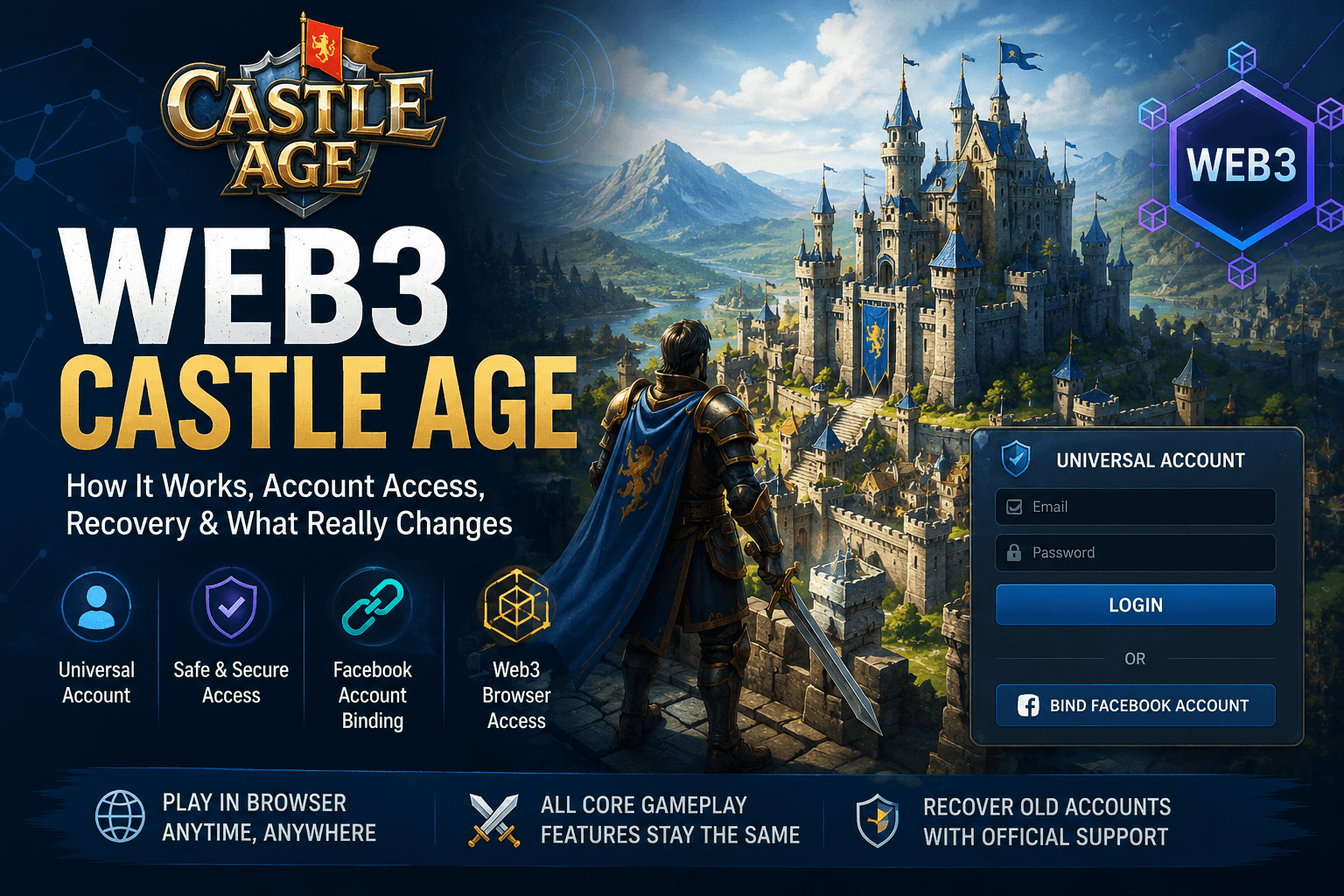
Web3 Castle Age is a browser-based way to access Castle Age through a Castle Age Universal Account. The official login page accepts a Crusaders of Castle Age email and password, while also providing a route for binding an older Facebook account to web access.
That distinction matters because a browser login and a crypto wallet solve different problems. A Universal Account manages access to the game; it doesn't by itself prove that game assets are controlled through blockchain keys.
The Castle Age Wiki describes Web3 and Web4 as official browser versions that let players access Castle Age without depending on Facebook. The official login page supports that account-based model.
How Do You Access Castle Age Without Facebook?
You can access Castle Age through the Web3 or Web4 browser portals without using Facebook for each login. New players use a Universal Account, while existing Facebook players can follow the account-binding process documented on the official login page.
For the Facebook registration route, the documented process is:
-
Reach at least Level 3.
-
Open the Crusaders of Castle Age option.
-
Register an email address and password.
-
Confirm the registration email.
-
Use those credentials to enter the Web3 portal.
The Castle Age Wiki identifies Level 3 as the point at which the Crusaders link appears under the Home menu for Facebook players. It also documents an iOS route through the More menu and Castle Age Account option.
A useful detail gets lost in many simplified guides: the Web3 route isn't merely a different visual version of Facebook Castle Age. Its account model is separate, which becomes especially important when an older account needs to be recovered.
How Do You Recover an Old Facebook Castle Age Account?
Existing Facebook players can request account binding for Web3/Web4 if they can provide enough information to verify ownership. The official login page asks for the character name, army code, and a Facebook Castle Age recharge order, with the page specifying support for recharge order numbers after 2018.
If the recharge order isn't available, the same page directs players to customer support. It lists information such as current level, base attack, base defense, base energy, base stamina, registration date, last-played date, and screenshots, along with the email and password the player wants to bind.
Imagine returning to Castle Age after years away and finding that your old Facebook login isn't getting you into the game. In that situation, the useful part of the Web3 system isn't a vague ownership claim; it's the documented recovery route that can connect the old account to an email login.
DECA Support also maintains a dedicated Castle Age section, including an article for changing a Web3 password and another addressing purchase problems on Web3/4.
Where Can You Play Web3 Castle Age?
Castle Age Web3 and Web4 are browser portals, so players can use a web browser rather than relying on a dedicated Android application. The Castle Age Wiki says the web versions provide the full game on mobile, while DECA maintains separate Web3/Web4 support information.
For mobile users, the distinction is practical. The Wiki identifies Web3 as the route for several iOS activities, including Conquest Duels and Festival activities such as Feats, Towers, and Duel Champion. Those platform details can change, so current official support should take priority over older community guides.
What Gameplay Features Stay the Same?
Moving away from Facebook doesn't turn Castle Age into a different genre. DECA's current support structure still covers battles, quests, raids, monsters, town systems, heroes, and other established Castle Age mechanics.
Army codes provide a specific example of how the web version handles player connections. The Castle Age Wiki says Web3/Web4 players can invite Facebook players using army codes instead of first adding them to a Facebook friend list.
So the practical change is mostly about access and account management rather than replacing the game's underlying fantasy-RPG systems.
Is Web3 Castle Age Really a Blockchain Game?
The available evidence doesn't justify treating the “Web3” label as proof of fully on-chain gameplay. Official Castle Age pages clearly document browser access, Universal Accounts, and Facebook-account binding, but they don't provide equivalent primary documentation establishing every NFT, token, or decentralized-gameplay claim made by third-party articles.
That matters because competing sources disagree. Blockchain Council describes Ethereum and blockchain features while also acknowledging that the game doesn't fully match typical decentralized Web3 mechanics. Bitrue also discusses Ethereum but says the game doesn't offer NFT or token rewards. Other publications make stronger claims about NFTs, tokens, or DAOs.
So what should a reader trust?
Start with primary evidence. An official contract address, documented wallet connection, identifiable token contract, or official announcement carries more weight than a blog repeating an unsupported feature claim.
This is also where readers searching Web3 news should be careful. A Web3 news website can report on a game's blockchain claims, but the publication itself doesn't make those claims official. The same standard applies whether you're reading a gaming blog, crypto publication, or daily Web3 news roundup.
A Universal Account isn't a crypto wallet. The former uses account credentials for access to Castle Age; the latter generally uses cryptographic keys that give a user control over blockchain assets.
How Can You Verify Web3 Castle Age Blockchain Claims?
Verify the feature rather than trusting the label. For claims about tokens, NFTs, or on-chain ownership, look for an official source that identifies the technology and, where applicable, provides verifiable blockchain information.
Use this five-point check:
-
NFT claim: Look for an official collection or contract address rather than a promotional screenshot.
-
Token claim: Look for an official announcement and an identifiable token contract.
-
Wallet claim: Check whether the official game actually documents wallet connectivity.
-
On-chain gameplay claim: Look for documented contracts or transactions tied to the claimed feature.
-
DAO claim: Look for actual governance mechanics rather than a community vote simply being described as a DAO.
MEXC's recent glossary entry makes a similar distinction: the documented evidence is clearer about browser access and account management than about fully on-chain gameplay.
This is the most useful way to read conflicting Castle Age coverage: instead of asking whether an article sounds convincingly “Web3,” ask what technical evidence it provides. That's particularly useful when comparing a current Web3 news report with older articles that may have repeated claims without linking to primary evidence.
What Is the Castle Age Web3 Mirror?
The Castle Age Web3 mirror is the browser route for accessing Castle Age through the Universal Account system rather than relying on Facebook login. The Castle Age Wiki lists Web3 and Web4 mirrors and explains their connection with Universal Accounts.
The official Web3 login page currently asks for a Crusaders of Castle Age email and password. It also provides account-binding instructions for players moving an older Facebook account to Web3/Web4.
If you're searching for the castle age web3 mirror, use an official Castle Age portal when entering account credentials. Avoid copying login details into unofficial pages that simply describe themselves as mirrors or Web3 game portals.
FAQ
These questions focus on the practical issues most likely to matter before creating an account, recovering an older one, or interpreting the game's Web3 terminology.
Can I play Castle Age without Facebook?
Yes. The Web3 and Web4 portals allow players to log in with a Castle Age Universal Account using an email address and password. Existing Facebook players can also use the documented account-binding process to move toward web access.
What level do I need to create a Universal Account?
For the Facebook registration route, the Castle Age Wiki says players need to reach Level 3 before the Crusaders link appears under the Home menu. The same source documents a separate iOS registration method, so the Level 3 requirement applies specifically to the Facebook route.
How do I create a Castle Age Universal Account?
Facebook-route players reach Level 3, open Crusaders, register an email and password, and confirm the registration email. The Castle Age Wiki also documents an iOS route through More and Castle Age Account, followed by email confirmation.
What is the Castle Age Web3 mirror?
The Castle Age Web3 mirror is the browser-based Castle Age access route associated with Universal Accounts. The Castle Age Wiki lists Web3 and Web4 as browser versions that allow players to access the game without remaining dependent on Facebook.
Can I recover an old Facebook Castle Age account?
Yes, if the account can be verified. The official login page requests details including the character name, army code and Facebook recharge order; if the order isn't available, players can provide additional account information to DECA support for binding.
Does Web3 Castle have an official crypto token?
The official access documentation reviewed here doesn't establish a Castle Age token. Any token claim should therefore be checked against an official Castle Age or DECA announcement and an identifiable contract rather than accepted from a third-party article alone.
Conclusion: What Should You Check Before Trusting a Web3 Game Claim?
A useful decision rule is to separate the access layer from the ownership layer. A game can provide browser-based Web3 access through an email account without proving that its items, currencies or governance systems operate on a public blockchain.
For Castle Age, the clearest documented evidence concerns Universal Accounts, Web3/Web4 browser access and Facebook-account binding. Claims beyond those functions should be judged by primary evidence, not by the label attached to the game.
This keeps the four keywords relevant to their surrounding topics rather than stuffing them into headings or repeating them unnaturally.