Writing
Web3 Dashboard Development Cost in 2026
Real cost ranges for Web3 dashboards in 2026 — from $800 MVPs to $50K custom builds. What actually drives price, and how to budget before you hire.
I get this question almost every week, usually from a founder who just got off a call with a developer who quoted $45,000, and another who quoted $600 for what sounds like the same project.
Both numbers are real. Both can be the right price.
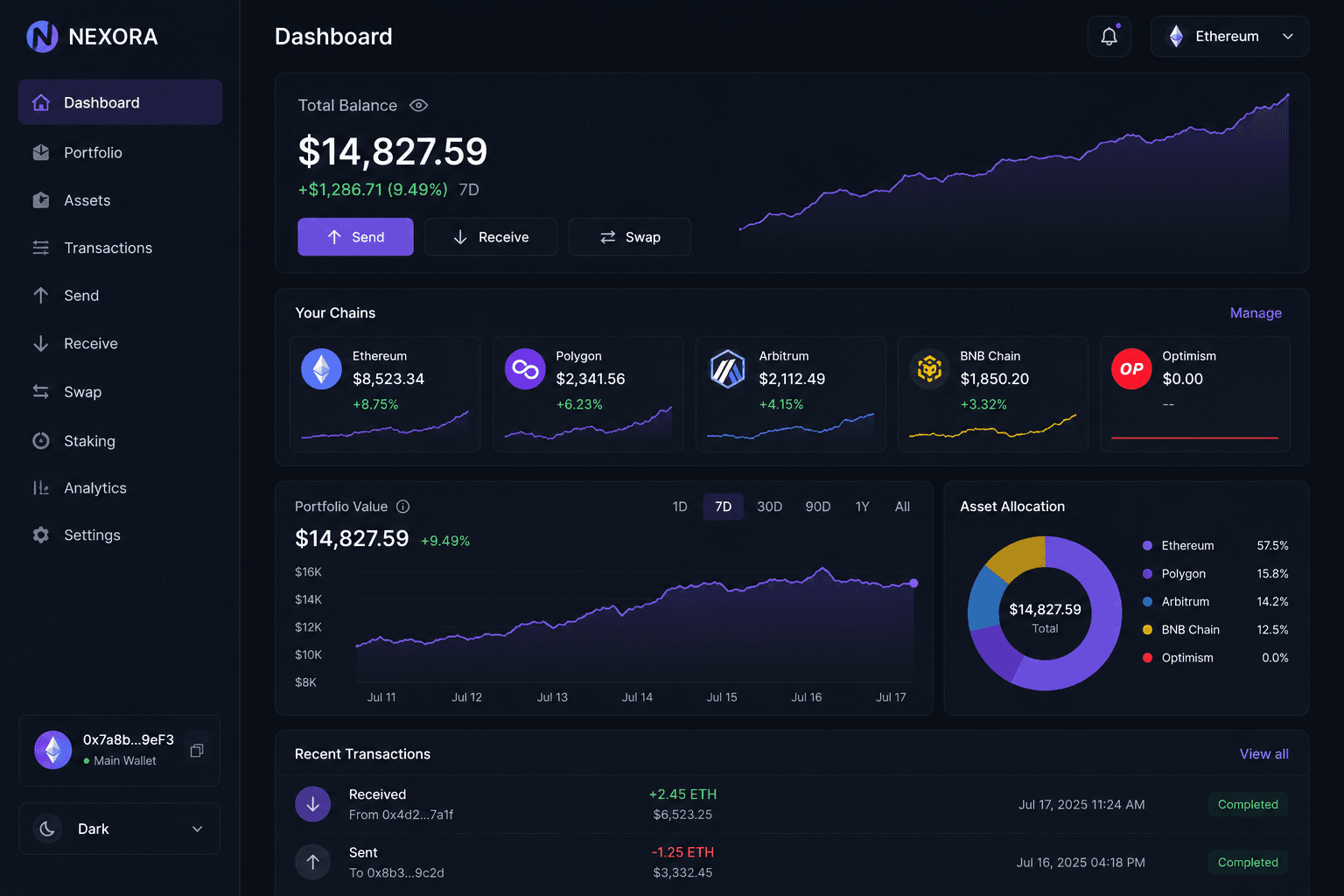
The gap exists because "Web3 dashboard" isn't one thing — it's a label people put on projects that range from a single wallet-connect page to a full trading interface pulling live data from six chains.
So before I give you numbers, I want you to understand why the range is this wide, because once you see the actual cost drivers, you'll stop asking "what does it cost" and start asking "what does mine cost" — which is a much more useful question, and one you can actually answer for yourself after reading this.
The Quick Answer
Here's the range, roughly, based on what I've seen quoted and what I've delivered myself.
| Tier | Scope | Typical Cost |
|---|---|---|
| MVP dashboard | Wallet connect, 1 chain, 1–2 views, no custom design | $800–$2,500 |
| Standard DeFi dashboard | Multi-wallet support, 2–4 chains, 4–8 views, basic design system | $3,000–$12,000 |
| Full product frontend | Custom design, 5+ chains, real-time data, complex states | $15,000–$50,000 |
| Retainer | Ongoing feature work, maintenance, new chain support | $2,000–$8,000/month |
Keep reading to understand what drives you toward each tier.
What Actually Drives the Cost?
Wallet Integration Complexity
Connecting one wallet type through something like RainbowKit is a solved problem — it's mostly configuration, not custom engineering.
But the moment you need to support multiple wallet standards, handle wallet switching mid-session, support both EVM and non-EVM chains, or build custom connection flows for a specific wallet your users keep asking for, you've turned a half-day task into a multi-day one.
Every extra wallet type is another set of edge cases: rejected connections, network mismatches, users on the wrong chain trying to sign a transaction that will fail.
Cost impact: Medium
Number of Chains
One chain means one RPC setup, one set of contract addresses, one set of assumptions about block times and gas.
Add a second chain and you don't just double the work — you have to build a chain-switching UI, handle assets that exist on some chains but not others, and decide what happens when a user's wallet is connected to the wrong network.
I've seen founders assume "multi-chain" is a checkbox. It's actually a parallel data layer for every chain you add, and past three or four chains, the complexity compounds rather than adds.
Cost impact: High
Data Sources: RPC vs APIs vs The Graph
This is the one non-developers underestimate the most.
Pulling data directly from an RPC node works for simple reads, but it's slow and painful for anything historical or aggregated — like "show me this wallet's transaction history" or "total value locked over the last 30 days."
For that, you want indexed data, which usually means The Graph if a subgraph already exists for the protocol you're building on, or a service like Moralis.
If no subgraph exists for your protocol, someone has to build one — and that's a separate, non-trivial job on top of the dashboard itself.
Cost impact: High
Number of Views
A "dashboard" with one screen — connect wallet and see balance — is a different animal from one with a portfolio view, a swap interface, a staking page, a transaction history table, and an admin panel.
Each view isn't just new UI. It's new data fetching, new loading and error states, and usually new logic for what happens when data is stale, missing, or the user is mid-transaction.
I generally estimate per-view, not per-project, because that's where the actual hours go.
Cost impact: Medium
Whether You Have a Figma Design
If you hand a developer a finished Figma file with every state designed — loading, empty, error, success — they build to spec and move fast.
If you don't have one, the developer is now also making design decisions: spacing, color, what an error message looks like, how a modal behaves on mobile.
That's not a bad thing, but it's time, and most developers either charge for it or produce something noticeably more generic.
A good design file can shave 20–30% off a quote because it removes ambiguity.
Cost impact: Medium
Real-Time vs Polling
Refreshing data every 30 seconds with something like TanStack Query is simple and cheap.
True real-time, where a price or position updates the instant it changes on-chain, usually means WebSocket subscriptions, event listeners, and handling reconnects gracefully when a user's Wi-Fi drops.
It's a genuinely different architecture, not a setting you flip on.
If your product doesn't actually need sub-second updates — and most don't — polling will save you real money without your users noticing the difference.
Cost impact: Medium
Freelancer vs Agency vs In-House
Freelancers
Freelancers are almost always the cheapest per hour and, if you find a good one, the fastest to ship an MVP.
The risk is availability — a freelancer juggling three clients might take two weeks to fix a bug that should take two hours.
Freelancers make sense for MVPs, one-off builds, and anything where you need speed more than long-term hand-holding.
Agencies
Agencies charge more — often 2 to 4 times what an individual developer would charge for the same work — because you're paying for project management, a bench of backup developers if someone leaves, and a support structure.
That markup is sometimes worth it if you need a team with frontend, design, and potentially smart-contract auditing coordinated under one roof.
But if your project is a single dashboard, you're often paying agency overhead for work one good freelancer could do alone.
In-House Developers
In-house only makes sense once you have ongoing, continuous frontend work — not a single project, but a product that will need new features every month for the next year or more.
A solid Web3 frontend developer in the US or Western Europe runs $110,000–$160,000/year in salary alone, before benefits, equity, and the time cost of hiring.
Do that math against a $4,000–$8,000/month retainer before you commit to a full-time hire.
For most early-stage founders, in-house is premature — you're paying for capacity you don't need yet.
My Recommendation
My honest advice: start with a freelancer for your MVP, move to a retainer once you know the product is working, and only build in-house once you have a real roadmap, not just a vision.
Questions to Ask Any Developer Before Hiring
You don't need to know how to code to ask good questions.
You need four questions that expose whether someone actually knows Web3 frontend work or is simply bolting a wallet-connect button onto a normal web app and calling it a dashboard.
1. How Do You Handle a User Switching Networks Mid-Session?
Good answer: They'll mention detecting the chain ID, prompting the user to switch or listening for the change event, and updating the UI state accordingly.
Red flag: A vague "we just refresh the page" or they seem unsure what you mean.
2. What Happens If an RPC Call Fails or Times Out?
Good answer: They'll describe fallback RPC providers, retry logic, and a visible error state so the user isn't staring at a blank screen.
Red flag: "That doesn't really happen."
It happens constantly, and anyone experienced knows it.
3. How Do You Cache or Refresh On-Chain Data?
Good answer: They mention something like TanStack Query for caching and refetch intervals and can explain the tradeoff between fresher data and RPC costs.
Red flag: They don't understand why this matters or say they'll "just call it whenever."
4. If We Need a New Chain Added in Three Months, What Does That Involve?
Good answer: An honest breakdown — new RPC configuration, contract addresses, potentially a new subgraph, and some UI work for chain switching.
Red flag: "Oh, that's easy, just a config change" for a chain with a genuinely different architecture.
That answer means they haven't done it before.
What to Budget If You're Not Sure Yet?
If you genuinely don't know your scope yet, here's how I'd think about it in ranges.
$800–$1,500: Proof of Concept
This gets you:
-
One chain
-
Wallet connect
-
Around 2 screens
-
No custom design
-
Polling instead of real-time updates
This is for validating an idea, showing investors something clickable, or testing whether people actually want the product before you invest more.
$1,500–$4,000: Real MVP
This can include:
-
Multi-wallet support
-
1–2 chains
-
A handful of views
-
Basic but coherent design
-
Sensible data fetching
-
Caching
This is what most early-stage DeFi founders should actually be budgeting for a first version.
$4,000–$12,000: Standard Production Dashboard
This is the range for a genuinely solid standard dashboard with:
-
Custom design implemented properly
-
3+ chains
-
Indexed data via The Graph or Moralis where it matters
-
Several polished views
-
Proper error states
-
Edge-case handling
-
Better transaction feedback
This is the range where the product starts to feel trustworthy to a user putting real money into it.
Be Careful With Extremely Low or High Quotes
A quote under $500 for anything beyond a single static screen usually means corners will be cut on error handling, edge cases, or security-adjacent details like transaction confirmation states.
These are the things that don't show up in a demo but matter the moment real users show up with real money.
And a quote north of $50,000 for a single dashboard, with no agency team or ongoing retainer attached, deserves a specific question:
What exactly is driving that number?
Sometimes it's justified. Often it's padding.
Final Thoughts
The real skill in budgeting a Web3 dashboard isn't finding the "right" price — it's understanding your own scope well enough that you can't be quoted wildly different numbers for the same thing.
Once you know your:
-
Chain count
-
Data source
-
View count
-
Wallet requirements
-
Design readiness
-
Real-time requirements
you can walk into any conversation with a developer or agency and know within a few thousand dollars what you should be paying.
If you've got a DeFi idea and you're trying to figure out which tier you actually fall into, I'm happy to talk it through with you — no charge, no pitch.
Book a free 20-minute call at calendly.com/developer-khalil and I'll help you scope it honestly, even if that means telling you where you can save money.
Khalil Ahmed is a frontend developer specializing in Web3 dashboards and DeFi interfaces. He builds with Wagmi, RainbowKit, The Graph, Moralis, and TanStack Query, and has shipped dashboards for protocols ranging from single-chain MVPs to multi-chain production products.