Writing
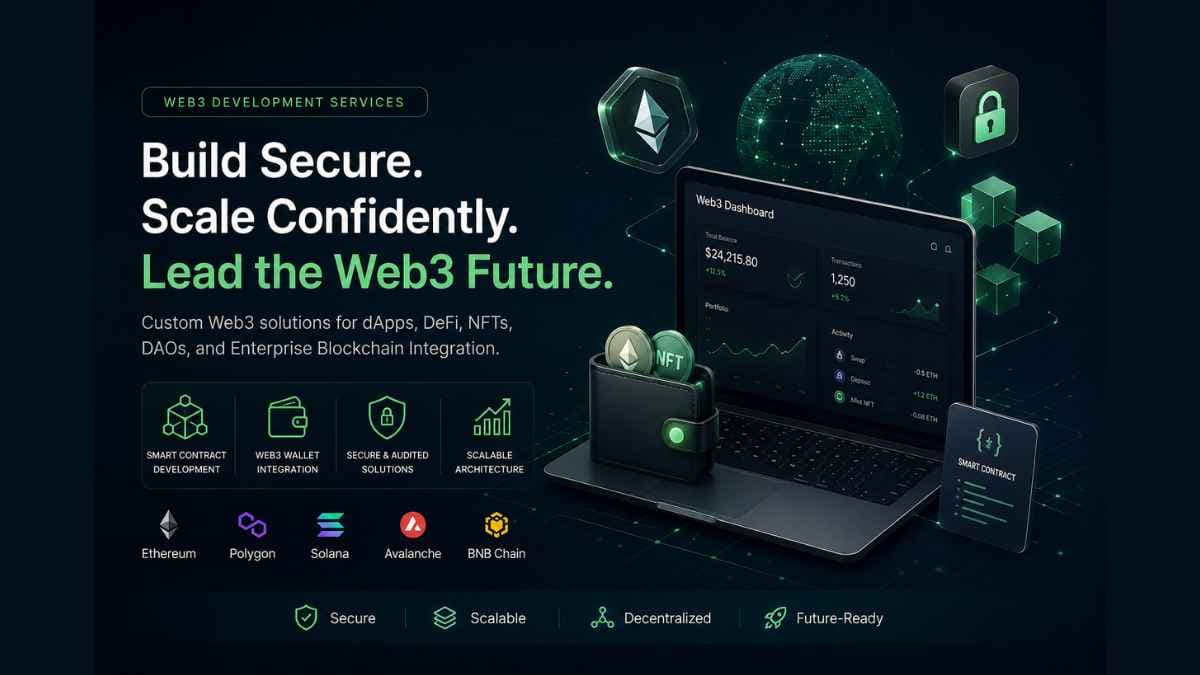
Web3 Development Services for Secure Apps
The key to a successful Web3 product is to begin with a genuine business need, rather than a trendy token concept. It needs careful architecture, good code, secure implementation, and a user-friendly interface, not a crypto dictionary.
The key to a successful Web3 product is to begin with a genuine business need, rather than a trendy token concept. It needs careful architecture, good code, secure implementation, and a user-friendly interface — not a crypto dictionary.
We provide Web3 development services for startups, enterprises, and product teams, from initial development to deployment. We can create a complete platform or enhance an existing product.
What Are Web3 Development Services?
Creation of blockchain-based products, such as decentralized storage, wallets, tokens, smart contracts, and dApps, are included in Web3 development services.
Major Web3 products employ both servers and the blockchain. Ownership or payments can be handled through blockchain, while private data, analytics, and notifications remain off-chain.
Web3 is helpful when there is a need for shared records, digital ownership, or automated rules in a project. Otherwise, a conventional database might be a better option.
Our Web3 And Blockchain Development Services
Some clients require a complete application. Others require the addition of a wallet connection, contract system, token model, or blockchain services feature to existing software.
You can use our blockchain development company and Web3 services to deliver either of these services, depending on the product, and not on a set package.
dApp And Smart Contract Development
We develop decentralized applications with responsive interfaces, backends, wallet connections, and tested contracts.
Marketplaces, payments, governance, membership systems, and digital ownership can be implemented in Solidity or Rust.
Each contract is designed with permissions, upgrade controls, gas fees, documentation, and deployment requirements in mind.
DeFi, Token, NFT, DAO, And Wallet Development
DeFi jobs can involve staking, lending, swaps, liquidity systems, and payment devices.
Utility, distribution, vesting, governance rights, and treasury controls can all be covered in token development.
We also develop NFT marketplaces, DAO voting systems, custodial wallets, and non-custodial wallet experiences.
The economic design is treated at the same level as the code since a technically functional token might have a fairly unhappy economic design.
Enterprise Blockchain Services And Web2-To-Web3 Integration
Often, there is no need to remake the existing software.
Wallet authentication, blockchain payments, token-gated access, traceability, digital identity, asset verification, and similar functionality can often be integrated via APIs.
For organizations that require controlled access, permissioned systems might be appropriate.
Cross-chain messaging, KYC, AML, privacy controls, and region restrictions can also be applied as per approved legal requirements.
Web3 Use Cases By Industry
The best use of Web3 is when it solves a known operational issue.
It can be used for:
-
Settlement and tokenized assets by fintech teams
-
Owned items and peer-to-peer marketplaces by gaming products
-
Provenance tracking by supply-chain businesses
-
Fractional assets by real-estate platforms
-
Verified records shared between different organizations
How Do We Choose The Right Blockchain And Architecture?
Key factors in determining the right blockchain are security, fees, speed, liquidity, privacy, and wallet support.
The architecture also dictates what remains on-chain and what stays off-chain.
Ethereum
Applications with high value, high security, and liquidity.
Polygon, Base, And Arbitrum
Suitable for cheaper EVM applications.
Solana
Suitable for fast and affordable applications.
Permissioned Blockchains
Suitable for enterprise systems that require controlled access.
Avalanche And BNB Chain
Appropriate for certain ecosystems and user requirements.
The optimum option will be appropriate for the technical and business needs of the product.
Our Web3 Technology Stack
We have developed contracts in Solidity and Rust, interfaces in React and Next.js, and application logic in TypeScript for reliability.
Smart Contract Development Tools
Hardhat and Foundry are used to develop and test contracts.
Frontend Development Technologies
React and Next.js are used to build responsive Web3 interfaces, while TypeScript supports reliable application development.
Technical decisions are transparent and avoid expensive surprises through a clear development process.
A product is developed at every step that the client can see before moving to the next stage.
What Does Our Web3 Development Process Include?
A clear process makes technical decisions transparent and minimizes costly surprises.
At each stage, a product is created that can be seen by the client before the next stage.
1. Discovery And Feasibility
Identify the users, objectives, risks, blockchain services, and success metrics.
2. Architecture And Prototype
Design contracts, data flows, interfaces, permissions, and integrations.
3. Product And Smart Contract Development
Implement approved features through reviewable milestones.
4. Testing And Security Review
Review contracts, applications, infrastructure, and administrative controls.
5. Deployment And Monitoring
Deploy the product, transfer repositories, document the product, and monitor live performance.
Independent auditors can audit contracts that control funds, ownership, upgrades, or sensitive permissions.
How Do We Secure Web3 Products?
Web3 security is not just about contract code.
Access to wallets, admin keys, bridges, oracles, frontend behavior, libraries, and infrastructure can all become weak points.
Web3 Security Practices
Threat modeling, role-based permissions, multisig administration, unit testing, integration testing, static analysis, fuzz testing, and audit remediation are a few of the processes we may employ.
Monitoring and incident planning continue after launch, as no audit can ensure long-term protection.
Our Web3 Development Experience
The truth of the matter outweighs pretty words.
Each case study should include:
-
The business problem
-
Product provided
-
Network
-
Technology
-
Security work
-
Time frame
-
Measurable result
Product screenshots, audit reports, repositories, contract addresses, and verified product reviews are published where client approval allows.
Clear ownership terms and the names of engineers also indicate accountability for delivery.
Web3 Landing Page Examples And Product Interfaces
Our Web3 landing page examples are not about art for art's sake; they're about making a product usable.
For each example, explain how the interface helped to reduce confusion, increase completion rates, or make blockchain services easier to understand.
How Much Do Web3 Development Services Cost?
The cost varies based on project size, smart contract complexity, integrations, design, audits, and support.
It may take several weeks for a basic token or contract to be created, while approximately 2–3 months may be required to create a dApp MVP.
Fixed Scope
Appropriate for a well-defined MVP.
Dedicated Team
Suitable for products with changing requirements.
Time And Materials
Good for projects that are research-intensive or flexible.
An accurate estimate should be based on approved requirements, not on a "quick message."
How Should You Choose A Web3 Development Company?
Check live products, contract history, chain experience, verified feedback, security measures, and support after launch.
What Should You Check Before Hiring?
Inquire about:
-
Ownership of repositories
-
Smart contracts
-
Credentials
-
Designs
-
Documentation
-
Security practices
-
Post-launch support
Any Web3 development company worth its salt should be upfront about compromises.
Avoid a crypto development company that guarantees complete security, immediate delivery, or guaranteed commercial success.
Conclusion
For a successful Web3 product, we must have a strong purpose, high-quality security, the right architecture, and a development team that can communicate clearly about both the Web3 space and the business objective.
Proper planning reduces unnecessary changes, technical risk, and post-launch problems.
FAQ
What Does A Web3 Development Company Do?
A Web3 development company designs, constructs, tests, deploys, and maintains products by employing smart contracts, wallets, blockchains, tokens, decentralized storage, APIs, and other software.
Which Blockchain Services Are Best For A Web3 Project?
The right blockchain services depend on security, cost, speed, liquidity, tooling, wallet support, interoperability, privacy, and the user base.
What Is The Difference Between Blockchain Services And Web3 Development?
Blockchain development services are dedicated to networks, ledgers, and contracts.
These services are then paired with interfaces, wallets, APIs, storage, identity, and complete user journeys to create full Web3 products.
Is Web3 Suitable For Every Business?
No. If there is no added benefit from distributed ownership, shared verification, or programmable assets, then standard software is often the better choice.