Writing
DeFi Holding: What Does It Really Mean?
Understand DeFi holdings, wallet assets, staking positions, yields, risks, and portfolio tracking with practical insights into DeFi dashboards and financial technology concepts.
The term refers to an historical company. DeFi Inc. was a legitimate company that was acquired in stages by Routemaster Capital in 2020 and 2021.
The only thing that's easy to ask is this: Are you describing an asset that you own, a position within a protocol, or the company that used to be called DeFi Holdings Inc.?
Editorial note: This article is an explanation of DeFi concepts and product mechanics. It's not personal investment advice.
What Is DeFi Holding?
DeFi holding means retaining a digital asset or financial position connected to decentralized finance. A wallet balance can be a simple holding, while a position deposited into a smart contract carries additional rules, dependencies, and potential sources of return.
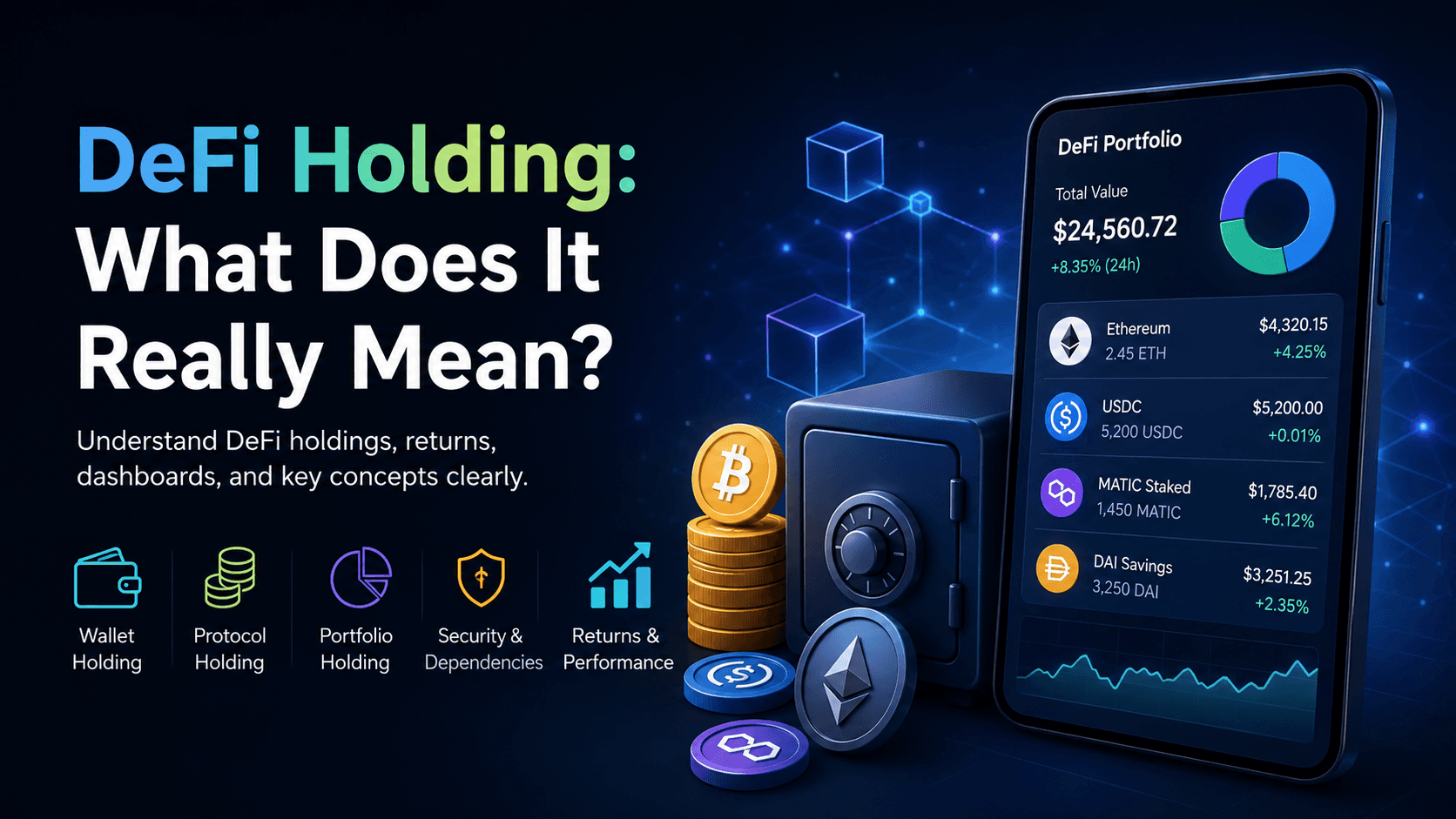
A practical way to separate the possibilities is through three layers:
-
Wallet holding: An asset remains in a wallet without being deposited into a protocol.
-
Protocol holding: An asset is committed to a DeFi application, such as a lending or staking system.
-
Portfolio holding: Several assets or protocol positions are managed together across wallets, networks, or applications.
That distinction matters because location changes exposure. A token sitting untouched in a wallet depends mainly on custody and the asset's market value. The same token deposited into a protocol can also depend on contract behavior, liquidity, network conditions, and the protocol's accounting.
How Does DeFi Generate Returns?
Having a DeFi token doesn't guarantee yield. Suppose a token remains in a wallet. A gain could come entirely from its market price increasing. Put the same asset into a lending or staking protocol, and the position may generate another form of return, but it also acquires additional dependencies.
APY is therefore not the same thing as total return. A displayed yield can change over time, while the market value of the underlying asset can move in the opposite direction.
The useful principle is to identify the source before judging the number. A percentage on a dashboard tells you how much is being quoted; it doesn't, by itself, explain why that return exists.
How Do You Evaluate a DeFi Holding Before Keeping It?
A useful way to assess a position is the HOLD Framework: Holding type, Origin of return, Liquidity, Dependencies, Security, and Exit. It starts with the structure of the position rather than its headline APY.
-
H — Holding type: What exactly do you own: a token, staking position, loan, or LP position?
-
O — Origin of return: Where does the return come from?
-
L — Liquidity: Is the position easily liquidable?
-
D — Dependencies: What contracts, chains, bridges and oracles does it depend on?
-
S — Security: What is the history of the contract, what are the controls, and what is the audit
-
E — Exit: What happens if a transaction fails or available liquidity changes?
Imagine two positions both displaying a 10% annualized return. One might depend on a protocol incentive paid in a volatile token. Another might generate fees from actual activity. The headline number is identical, but the mechanisms behind it are not.
A real dashboard review makes this distinction visible. If a position page shows only an asset name and percentage yield, a reader still has to reconstruct the important details elsewhere. The HOLD framework instead asks for those details before treating the position as understood.
How Can a DeFi Dashboard Track Holdings?
A DeFi dashboard can provide a single interface for wallet balances, staking positions, protocol data, transaction history, and other blockchain information. It does not change ownership; it's meant to display information from the wallets, APIs, and blockchain sources in a way that users can view.
Khalil Ahmed's DeFi portfolio dashboard case study documents a production project built around a specific user need: answering what a user currently holds and how those positions are performing without checking several separate tools. Wallet balances, staking positions, reward accruals, historical activity, and protocol-level data came from different APIs and blockchain sources. (Khalil Ahmed)
The implementation used parallel requests instead of making one slow source block the rest of the page. It also used caching, targeted memoization, reusable interface components, and different refresh behavior for fast-changing balances and slower historical information.
What Should a DeFi Dashboard Show?
A good dashboard should help every position answer four questions: What is it? Where is it? How is it earning? How can it be exited?
Useful fields can include asset balance, position value, protocol, network, yield source, transaction status, and data timestamp. The exact fields depend on the protocols being tracked.
The Khalil Ahmed dashboard case study shows why loading and empty states also belong in this conversation. It had different data sources with different response times and rate limits, so the implementation did not assume that all data would arrive at the same time.
What Is FinTech and How Is It Different From DeFi?
FinTech refers to the technology that is employed to provide or enhance financial services, whereas DeFi is a term that refers to financial applications and assets that are developed using blockchain networks and smart contracts. The two are not synonymous, but they can be used together.
A mobile banking application is FinTech without being DeFi. A blockchain-based lending protocol is DeFi and can also be considered financial technology.
The boundary can become less obvious at the product layer. A DeFi interface may rely on centralized APIs, infrastructure providers, analytics services, or other off-chain components even though the financial position itself uses blockchain-based protocols.
For the practical development side, Khalil Ahmed's Web3 and DeFi work includes examples involving wallets, staking, DeFi positions, dashboards, and transaction experiences.
Where Does DeFi Development Fit Into DeFi Holdings?
DeFi development sits on the software side of the experience. Wallet connections, token interfaces, dashboards, protocol interactions, and blockchain data layers influence how users see and interact with their positions.
A defi exchange development company may build trading interfaces and supporting infrastructure, while defi wallet development services focus on wallet connection, transaction signing, network handling, and related user flows. Those are connected to the holding experience, but they address a different commercial intent from someone trying to understand the term itself.
The same distinction applies to a defi token development company, a defi application development company, and teams hiring defi developers. A product may also require defi app development services to connect protocol data and user actions through one interface.
FAQ
What Does a DeFi Exchange Development Company Build for DeFi Holdings?
A DeFi exchange development company builds platforms for swapping, trading, depositing, and managing digital assets, the key features include clear balances, transaction status, network support, and asset tracking.
When Do DeFi Wallet Development Services Matter for Holding DeFi Assets?
DeFi wallet development services help users connect wallets, sign transactions, switch networks, and manage assets.
What Does a DeFi Application Development Company Add to a DeFi Portfolio?
A DeFi development company builds interfaces for staking, lending, liquidity provision, and portfolio tracking. These tools help users see where assets are deployed instead of viewing only a basic wallet balance.
How Does DeFi Token Development Affect a DeFi Holding?
DeFi token creates tokens designed for uses such as governance, rewards, or protocol participation.
When Would You Need a DeFi Token Company?
A DeFi token firm can produce tokens for governance, rewards, or particular protocol capabilities. Users need to be aware of what the token is and how it plays a role in the app's economy.
What Do DeFi App Development Services Have to Do With DeFi?
DeFi app development services create interfaces for interacting with lending, staking, liquidity, and other protocol positions.
What Should You Look for in DeFi Developers Building Holding and Portfolio Tools?
DeFi developers should understand wallet connections, blockchain data, protocol APIs, and transaction state; they should also handle data delays clearly instead of presenting an outdated balance as current.
what is fintech and defi?
FinTech is the broader category covering technology used in financial services. DeFi is a blockchain-based approach to financial applications and transactions, so a product can belong to both categories without the terms meaning the same thing.
Conclusion
A useful decision rule is to describe a position by its location, mechanism, and exit path, rather than by its token name alone. That gives a clearer picture of what can affect the position after it enters a protocol.
That rule also changes how portfolio software should be designed. A balance of “100 tokens” is only a starting point. A more useful record tells the reader which network holds them, which protocol is involved, where the return originates, when the data was refreshed, and what action would be required to exit.
The better question, then, isn't simply “What do I hold?” It is “What position have I actually created?”